

The global 3PL market is projected to hit $1.22 trillion this year, yet many retailers still struggle with the same manual errors and inventory blind spots. If your current logistics setup feels like a bottleneck during peak seasons, you aren’t alone. Most brands realize too late that a warehouse isn’t a strategy. Successfully evaluating 3pl providers for retail in 2026 requires moving beyond price per pallet. You need a partner that integrates directly with your tech stack to eliminate data silos and stop hidden surcharges from draining your bottom line.
We’ve built this guide to help you master the selection criteria for a partner that scales with your omnichannel brand. You’ll learn how to identify providers that offer true warehouse optimization and network design rather than just floor space. We’ll examine the critical benchmarks for 2026, including compliance with new FMCSA financial responsibility rules and CPSC electronic filing requirements. By the end of this article, you’ll have a roadmap to transform your supply chain from a cost center into a predictable, high-speed growth engine.
Key Takeaways
- Shift your logistics from a cost center to a strategic asset by prioritizing omnichannel capabilities and unified inventory pools.
- Distinguish between tactical 3PL execution and strategic 4PL orchestration to choose the model that fits your long-term growth trajectory.
- Master a data-driven vetting framework for evaluating 3pl providers for retail that focuses on SKU velocity and category-specific expertise.
- Ensure EDI compliance and seamless integration with major retailers like Walmart and Amazon to avoid penalties and streamline operations.
- Discover how expert-vetted matching services can replace manual searches with precise, data-backed partner recommendations.
The Evolution of Retail Distribution Logistics in 2026
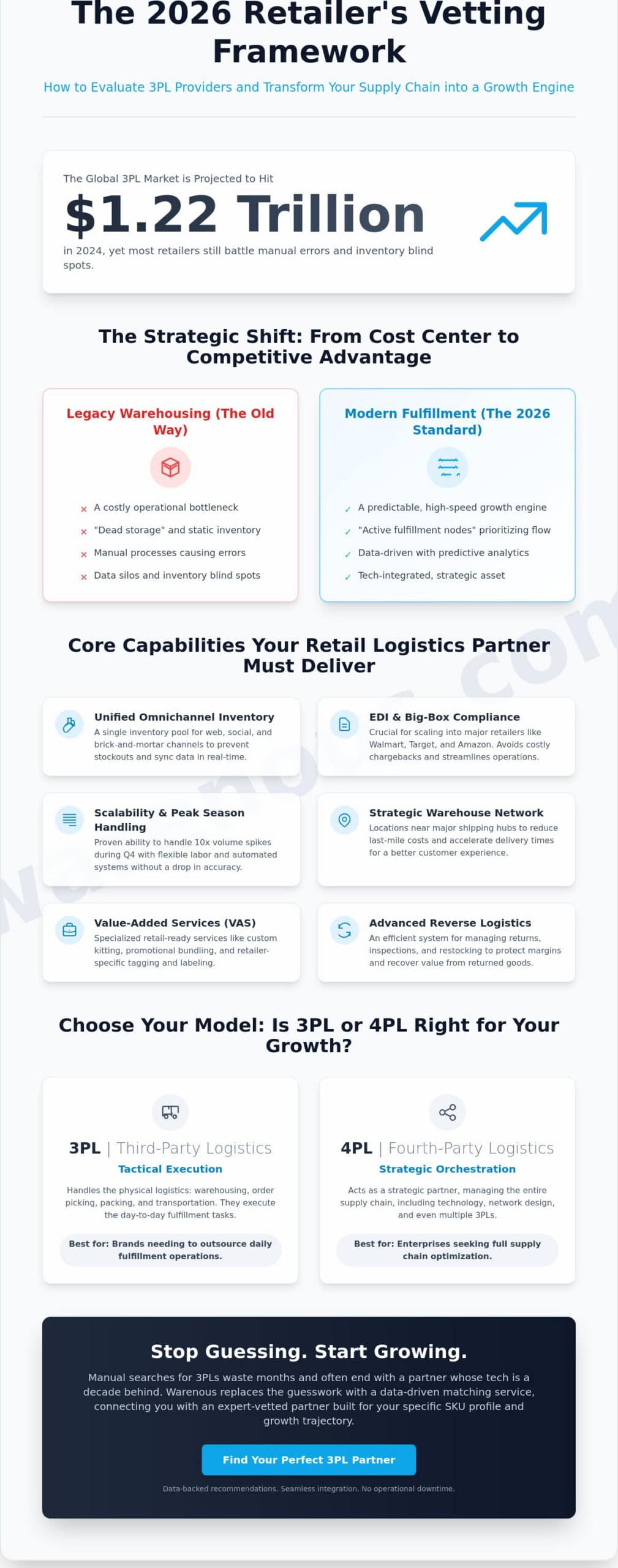
Logistics in 2026 has moved past the era of “dead storage.” In the past, a warehouse was simply a place where inventory sat until someone bought it. Today, the most successful brands view their logistics partner as a strategic third-party logistics (3PL) or 4PL asset. This shift is mandatory for survival. Legacy warehousing can’t keep up with the high-velocity demands of modern retail. If your inventory isn’t moving, it’s costing you more than just shelf space; it’s draining your operational agility. When evaluating 3pl providers for retail, you must look for “active fulfillment nodes” that prioritize flow, data accuracy, and speed over simple square footage.
Why Retail Logistics Requires a Specialized Approach
Retailers face unique pressures that standard industrial 3PLs aren’t equipped to handle. High SKU counts and rapid turnover cycles require surgical precision. Your partner must be “retail-ready” from day one. This involves more than just picking a box. It requires:
- Custom Kitting: Grouping products for promotions or subscription boxes.
- Value-Added Services: Specialized tagging and labeling that meets strict big-box retailer standards.
- Reverse Logistics: Managing the complex cycle of returns, inspections, and restocking to protect your margins.
The Move Toward Data-Driven Supply Chain Partnerships
The top-performing 3PLs in 2026 are essentially software companies that happen to operate warehouses. They use AI and real-time data to provide the visibility you need to make fast decisions. Predictive analytics now allow these providers to suggest inventory placement near consumer hubs before the orders even arrive. This level of foresight is why software-first 3PLs are outperforming traditional, manual-heavy providers. They offer a tech-integrated supply chain that acts as a strategic asset rather than a hidden cost.
Finding this level of sophistication is difficult and time-consuming. Most brands waste months evaluating 3pl providers for retail only to discover that the provider’s tech stack is a decade behind the market. Warenous bridges this gap. We provide data-driven insights and expert 3PL matching services to connect you with a partner that fits your specific SKU profile and growth goals. We focus on warehouse optimization and network design to ensure your supply chain is built for the future. You get a partner that scales, and we ensure the transition is handled with professional project management to eliminate operational downtime.
Core Capabilities Your Retail Logistics Partner Must Deliver
In 2026, a 3PL that can’t sync your social commerce orders with your physical store inventory isn’t just behind the times; it’s a liability. When evaluating 3pl providers for retail, you aren’t just looking for a vendor. You’re auditing a technical infrastructure. Modern retail demands a unified inventory pool. This means your stock for web, social, and brick-and-mortar channels resides in one digital environment, allowing for real-time allocation based on demand velocity. Without this, you’ll face the dreaded “out of stock” notification on one channel while inventory gathers dust on another.
Compliance is another non-negotiable hurdle. If you plan to scale into big-box retail, your partner must be EDI compliant. Retailers like Walmart, Target, and Amazon have strict data standards and labeling requirements. Failure to meet these leads to costly chargebacks that can wipe out your margins. A U.S. government analysis on supply chain resilience highlights how standardized data exchange reduces bottlenecks, making EDI expertise a core requirement for any growing brand. If you’re struggling to find a partner with these specific technical credentials, using a service for 3PL matching can save you months of manual vetting.
Scalability and location are the final pillars of the physical network. Your partner must demonstrate the ability to handle 10x volume spikes during Q4 without a drop in accuracy. This requires a flexible labor model and automated sorting systems. Simultaneously, their warehouses must be strategically positioned near major shipping hubs. Proximity to these hubs isn’t just about speed. It’s about reducing last-mile costs, which typically account for a significant portion of your total fulfillment spend.
Technology Integration: WMS, ERP, and Beyond
Seamless API connections to Shopify, Amazon, and your internal ERP systems are mandatory. You need real-time visibility for ‘Track and Trace’ capabilities to keep customers informed and reduce support tickets. A Warehouse Management System (WMS) is the central nervous system of retail distribution, coordinating every movement from receiving to the final mile. If a provider’s WMS can’t offer a live data feed into your dashboard, they aren’t the right fit for a high-growth retail brand.
Value-Added Services (VAS) for Modern Retail
Modern fulfillment goes far beyond the “brown box” experience. When evaluating 3pl providers for retail, look for those offering sophisticated Value-Added Services. This includes custom packaging and branding to enhance the customer unboxing experience, which is vital for D2C loyalty. They should also handle subscription box assembly and complex kitting with ease. Finally, ensure they provide rigorous quality control and inspection services at the point of fulfillment to catch manufacturing defects before they reach your customer’s doorstep.
Comparing Logistics Models: Is 3PL or 4PL Right for Your Growth?
Choosing between a 3PL and a 4PL model isn’t just about the size of your business. It’s about the level of control and orchestration your retail brand requires. A 3PL focuses on tactical execution. They own the trucks, manage the warehouse, and physically move your goods. In contrast, a 4PL acts as a strategic layer above the physical assets. They don’t necessarily own the warehouses. Instead, they manage your entire supply chain network, often coordinating multiple 3PL providers to ensure global efficiency. Evaluating 3pl providers for retail often leads to the realization that your brand needs more than just a place to store boxes; it needs a system that can think.
3PL: The Tactical Powerhouse
This model is ideal for brands that need direct control over specific regional facilities. You get hands-on execution and generally lower overhead because you aren’t paying for an additional management layer. The main advantage is the simplicity of the relationship. You deal directly with the people handling your products. However, the downside becomes apparent as you scale. Managing three different 3PLs in three different countries creates massive data silos and operational friction. If your team is spending more time on emails than on strategy, you’ve hit the limit of the traditional 3PL model.
4PL: The Strategic Orchestrator
A 4PL is the best fit for global retailers with complex, multi-region supply chains. They provide a single point of contact for your entire logistics network. This model excels at high-level network design and data-driven insights. While management fees are higher, the efficiency gains from a unified strategy often outweigh the costs. The risk here is a lack of direct influence over the warehouse floor. You’re trusting the 4PL to manage the 3PLs effectively on your behalf. It’s a move toward total outsourcing of supply chain intelligence.
For many growing brands, the jump to a full 4PL is too expensive or unnecessary. This is where a hybrid approach becomes the most efficient solution. Warenous provides the strategic oversight of a 4PL through specialized 3PL matching and network design without the heavy management fees. We use data to find the perfect fit for your specific SKU profile and then offer the project management and warehouse optimization tools to keep that relationship running smoothly. This allows you to maintain the cost benefits of a 3PL while gaining the technological superiority of a managed network. Evaluating 3pl providers for retail becomes a scientific process when you have the right data-driven partner in your corner.
The Retailer’s Vetting Framework: Evaluating 3PL Providers Without the Guesswork
Stop selecting partners based on the lowest pick fee. It’s a race to the bottom that ends in late shipments and customer churn. A structured framework removes the emotion from the decision and replaces it with cold, hard data. When evaluating 3pl providers for retail, you must treat the process as a technical audit of their operational limits. Your goal is to find where the provider breaks before you sign the contract.
The first step involves a deep dive into your own data. Conduct an operational audit of your SKU velocity and volume. High-velocity items require different warehouse slotting and labor strategies than slow-moving inventory. Once you understand your profile, verify the 3PL’s experience with your specific product category. A provider that excels at heavy furniture may lack the precision required for high-end apparel or cosmetics. Request case studies that specifically highlight their “peak season” performance. Don’t settle for averages; ask for their order accuracy and throughput numbers from the busiest weeks of Q4. Finally, audit their tech stack for native compatibility with your sales channels and assess their financial stability. A partner that isn’t investing in their own facilities won’t have the capital to scale with your brand.
The 15-Question Vetting Checklist
Your RFP should be aggressive and specific. Inquire about their “Perfect Order Rate” and ask if they offer formal “Order Accuracy” guarantees. You need to uncover hidden surcharges, such as account management fees, packaging material markups, or steep storage minimums that can erode your margins. It’s also vital to ask about their labor stability during the holiday rush. Specifically, ask what percentage of their Q4 workforce is temporary staff versus full-time employees, as high turnover directly correlates with picking errors. If the vetting process feels overwhelming, leveraging professional 3PL matching can help you filter for providers that have already passed these rigorous standards.
Understanding the True Cost of Fulfillment (TCOF)
Focusing solely on the “price per pick” is a tactical error. You must calculate the Total Cost of Fulfillment (TCOF), which includes the cost of customer churn caused by poor logistics. A cheap partner that delivers a 2% error rate is far more expensive than a premium partner with a 0.2% error rate when you factor in reshipping costs and lost lifetime value. Consider the ROI of a partner that can reduce transit times by even 24 hours. In a market where speed is a competitive advantage, that one-day difference can significantly improve your conversion rates and customer loyalty. Precision in logistics isn’t just an operational goal; it’s a financial imperative.
Beyond the Search: Streamlining Procurement with Warenous
The manual process of evaluating 3pl providers for retail often consumes hundreds of hours that your leadership team doesn’t have. Most brands get stuck in a loop of generic RFPs and surface-level facility tours. This traditional approach is prone to human error and often leads to partnerships based on proximity rather than performance. Warenous changes this dynamic by acting as a risk-mitigation layer. We provide a data-driven matching service that is free for retailers, ensuring you connect with a partner that is expert-vetted and technologically compatible with your specific SKU profile.
We don’t just provide a list of names. We use deep data-driven insights to analyze your order volume, seasonal spikes, and technical requirements. This allows us to find the “perfect fit” provider who has already demonstrated success in your specific product category. Beyond the initial match, we offer warehouse optimization consultancy to improve your existing setups. If your current operations are sluggish, we identify the bottlenecks and implement the network design changes needed to restore efficiency. Our goal is to transform your logistics from a source of anxiety into a measurable competitive advantage.
The Warenous Matching Methodology
Our methodology relies on a pre-screened global network of top-tier 3PL providers. We’ve already done the heavy lifting of auditing their financial stability, tech stack latency, and labor models. When we match your operational profile with a facility, we look at specialized capabilities like temperature control, high-security storage, or complex kitting lines. One of our most significant advantages is having a logistics expert negotiate on your behalf. We understand the industry’s pricing structures and can identify hidden surcharges before you sign, ensuring your fulfillment costs remain predictable as you scale.
Implementation and Continuous Optimization
A successful match is only the beginning. The transition to a new provider is a high-risk period that requires precise project management. We manage this transition to ensure zero downtime for your sales channels. Our team stays involved to oversee the integration of your WMS and ERP systems, making sure data flows correctly from day one. Once you are live, we provide ongoing warehouse optimization services. As your brand grows and your SKU count expands, we refine your network design to keep shipping times fast and overhead low. Precision is a continuous process, not a one-time event.
Find your ideal retail logistics partner with Warenous today.
Future-Proof Your Retail Supply Chain for 2026
Logistics is no longer a back-office function. It’s the engine of your brand’s growth. Success in 2026 depends on shifting from stagnant warehousing to a dynamic, tech-integrated fulfillment network. You’ve seen that the process of evaluating 3pl providers for retail requires a deep audit of technical compatibility and operational resilience. Don’t let manual vetting or hidden surcharges slow your expansion. By focusing on omnichannel capabilities and total cost of fulfillment, you protect your margins and your customer loyalty.
Modernizing your supply chain shouldn’t be a guessing game. You can bypass months of trial and error by leveraging our global network of pre-screened 3PLs. Our expert-led logistics procurement ensures you find a partner that matches your specific SKU profile and technical needs. It’s a zero-cost service for retailers that provides the data-driven insights you need to scale with confidence. Get a Free 3PL Match for Your Retail Business. Your brand deserves a logistics partner that acts as a strategic asset, not just a warehouse. Take the first step toward a more predictable and scalable future today.
Frequently Asked Questions
What is a retail distribution logistics partner?
A retail distribution logistics partner is a strategic asset that manages the movement and storage of goods across multiple sales channels. They integrate directly with your e-commerce platforms and physical store systems to ensure inventory is available wherever your customers shop. Unlike traditional storage providers, these partners focus on high-velocity fulfillment and omnichannel accuracy to protect your brand’s reputation.
How does a 3PL differ from a standard warehouse?
A 3PL provides a comprehensive suite of fulfillment services, including picking, packing, and advanced technology integration, whereas a standard warehouse often only offers static storage. 3PLs act as an extension of your operations, providing the data-driven insights needed for effective network design. They prioritize inventory movement and SKU-level precision over simple pallet positions, making them essential for modern retail.
Why is EDI compliance important for retail logistics?
EDI compliance is mandatory for brands selling through big-box retailers like Walmart, Target, or Amazon to ensure automated and error-free data exchange. It eliminates manual entry errors and prevents the costly chargebacks that can drain your margins. When evaluating 3pl providers for retail, you must verify their technical ability to handle these specific electronic data standards to ensure a seamless partnership.
How much does it cost to use a 3PL matching service like Warenous?
Our 3PL matching service is free for retailers, as our costs are covered by our network of pre-screened providers. This model allows you to access professional project management and data-backed recommendations without any upfront fees. You gain a significant strategic advantage by finding the “perfect fit” partner without the financial risk or time drain of a manual search.
Can a retail logistics partner handle international shipping?
Yes, specialized retail 3PLs manage international fulfillment by leveraging global warehouse networks and automated documentation systems. They use real-time tracking to maintain visibility across borders and ensure compliance with local regulations. While we don’t offer freight forwarding directly, we help you find partners whose network design specifically includes these international capabilities to support your global growth.
How do I know if I am ready to outsource my logistics?
You’re ready to outsource when fulfillment errors begin to impact customer loyalty or when your internal team spends more time packing boxes than growing the business. If your current setup lacks the scalability to handle Q4 spikes or the technology to sync omnichannel inventory, it’s time to transition. Outsourcing provides the professional infrastructure needed to support high-volume, modern retail growth.
What happens if my 3PL fails during peak season?
A failure during peak season usually results from inadequate labor planning or outdated warehouse technology. To mitigate this risk, you should prioritize evaluating 3pl providers for retail based on their historical performance data and “Perfect Order Rate” guarantees. Using a professional matching service ensures your provider has been expert-vetted specifically for peak-season resilience and operational stability.
How long does it take to transition to a new logistics partner?
A standard transition typically takes between 30 and 90 days, depending on your SKU count and the complexity of your system integrations. This timeline includes critical steps like data migration, physical inventory transfer, and warehouse staff training. Our project management services focus on streamlining this entire process to ensure zero operational downtime during your move to a more efficient partner.