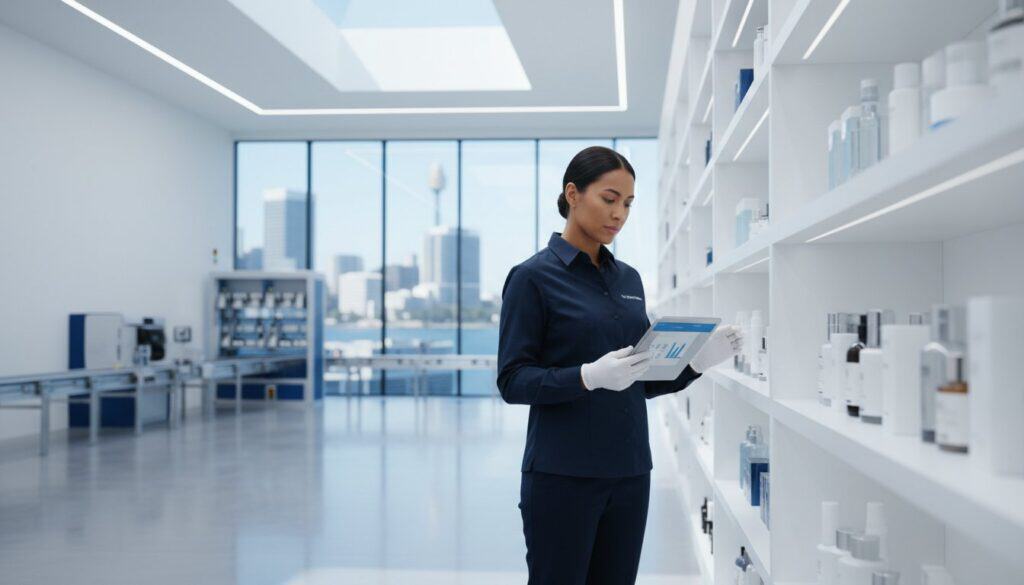
Beauty logistics has some unique challenges and requirements compared to other categories. Finding the right cosmetics and beauty 3PL warehouse isn’t just about finding someone who can move boxes. It’s about maintaining the clinical integrity of your formulas under strict environmental controls.
You’ve likely faced the frustration of melted inventory, high SKU errors, or PR kits that arrived looking like an afterthought. These operational failures don’t just cost money; they erode customer trust. This strategic guide teaches you how to master these complexities and identify a pre-vetted partner that safeguards your inventory and your reputation. We’ll explore how to ensure MoCRA compliance, optimize your warehouse network for zero-spoilage, and implement the data-driven insights needed for a seamless ERP integration. It’s time to replace manual friction with a scalable, tech-forward fulfillment strategy that actually protects your bottom line.
Key Takeaways
- Define the specific environmental and regulatory requirements your brand needs to maintain formula integrity.
- Audit potential cosmetics and beauty 3PL services using a rigorous 5-step framework focused on real-time monitoring and FDA registration.
- Learn why generalist providers often fail beauty brands. They don’t provide the specialized care or cleanliness needed for fragile inventory.
- Streamline your procurement process with data-driven insights that match your unique SKU complexity to the right operational partner.
What Are Cosmetics and Beauty 3PL Services?
Success in the beauty industry depends on more than just a viral formula. It requires a specialized operational infrastructure designed to handle high-value, sensitive inventory. Cosmetics and beauty 3pl services are specialized subsets of Third-party logistics (3PL) tailored specifically for the personal care sector. Unlike generalist providers who move bulk hardware or dry goods, these specialists understand that a single degree of temperature fluctuation can ruin an entire production run of active serums.
This niche covers four primary sectors: skincare, color cosmetics, hair care, and fragrances. Each category brings unique logistical hurdles. Fragrances require hazardous material expertise. Color cosmetics demand extreme SKU precision. Skincare necessitates strict environmental stability. Generalist providers often fail because they lack the “clean room” mentality required for beauty standards. They treat your products as commodities, leading to cross-contamination or regulatory non-compliance that can trigger expensive audits or retail chargebacks.
By 2026, the industry has shifted. Logistics centers are no longer just storage sites. They’ve evolved into integrated brand experience hubs. This means your 3PL choice directly influences your brand equity through flawless execution and technological integration. It’s the difference between a functional supply chain and a competitive advantage.
The Core Components of Beauty Fulfillment
Precision is the baseline. Effective fulfillment in this space relies on three critical pillars. First, climate-controlled warehousing is non-negotiable. Most cosmetics require a stable range between 18 and 24°C to prevent ingredient separation or melting. Second, you need high-density SKU management. A single lipstick line might have 50 shades. Your system must track every lot and expiration date with surgical accuracy. Finally, true cosmetics and beauty 3pl services must offer omni-channel capabilities. Your partner should seamlessly transition between shipping a single D2C order and preparing a 20-pallet B2B shipment for major retailers.
Why Your Logistics Partner is Your Brand Guardian
In beauty, the unboxing experience is your second marketing campaign. A leaked bottle or a cracked palette doesn’t just result in a refund. It kills customer retention. Professional 3PL precision ensures that every glass component and delicate liquid arrives intact. High-growth brands use logistics to build trust, not just to fulfill orders. When your operational partner prioritizes protective kitting and exact picking, they protect your margins from the “death by a thousand cuts” caused by returns and damages. Ultimately, beauty 3PL is the critical pillar of the customer lifecycle that transforms a first-time buyer into a brand loyalist.
The 4 Non-Negotiables of Beauty Logistics: Temperature, Compliance, and Precision
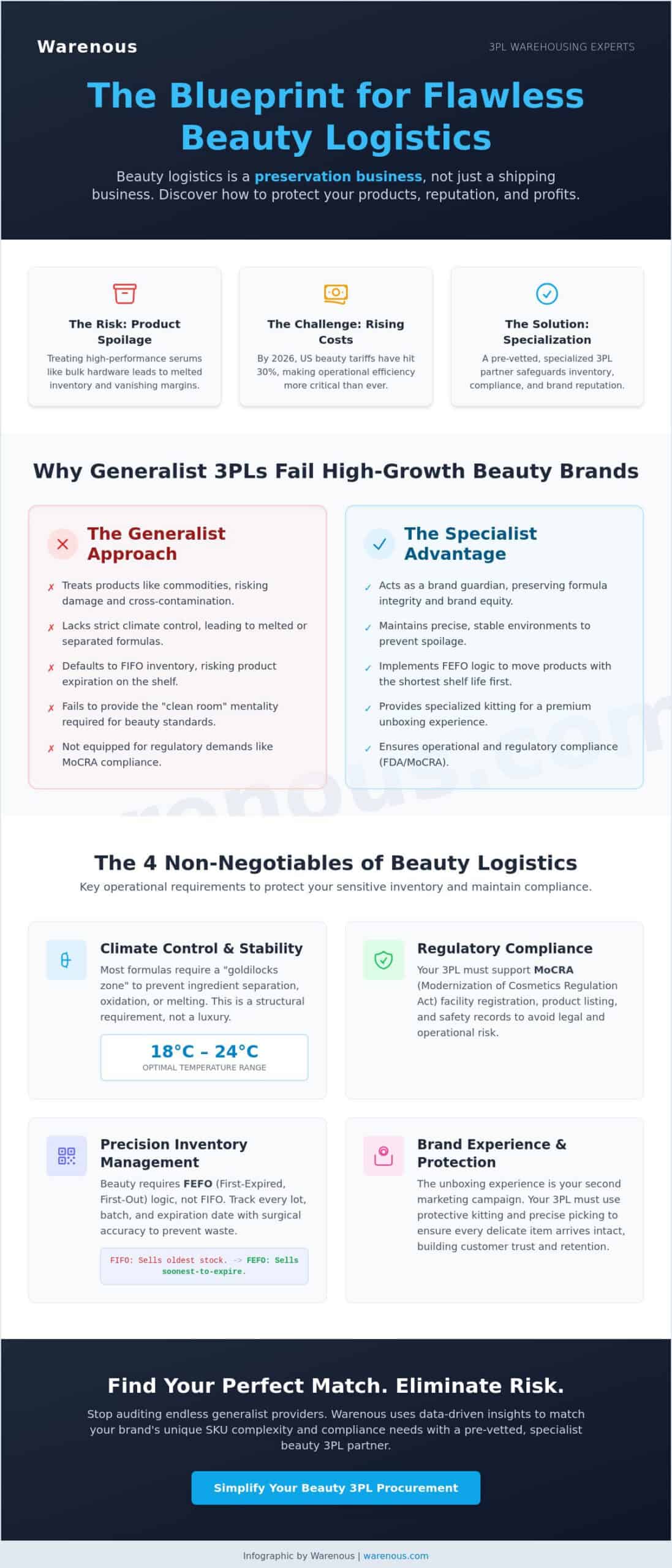
Environmental stability isn’t a luxury in beauty logistics; it’s a structural requirement. Beauty products are chemically sensitive assets. Most high-performance formulas require a “goldilocks zone” between 18 and 24°C to prevent ingredient separation, oxidation, or melting. When cosmetics and beauty 3PL services fail to maintain these tight parameters, the result is unsalable inventory and destroyed margins. Precision warehousing ensures that your active ingredients remain potent from the moment they arrive until they reach the customer’s vanity.
Compliance is the second pillar. As of 2026, navigating the Modernization of Cosmetics Regulation Act (MoCRA) is mandatory. Your logistics partner must support your facility registration and product listing requirements while maintaining “adequate substantiation of safety” records. This regulatory burden has fundamentally shifted the landscape. If your current provider isn’t up to speed on these best practices for cosmetic warehousing, you’re carrying unnecessary legal and operational risk. If you need to find a facility that meets these exact technical standards, data-driven 3PL matching can help you filter for compliant providers instantly.
Mastering FEFO and Lot Tracking
Generalist 3PLs often default to First-In, First-Out (FIFO) inventory management. This is a critical error for beauty brands. You need First-Expired, First-Out (FEFO) logic to ensure products with the shortest remaining shelf life move first. A modern Warehouse Management System (WMS) must track batch numbers and expiration dates with digital precision. This technical setup prevents “dead stock” by automatically prioritizing older inventory for promotional sales. It also makes product recalls surgical instead of systemic. You can isolate and hold specific lot numbers in seconds rather than freezing your entire inventory.
Hazardous Materials and Fragrance Shipping
Fragrances present a unique logistical challenge due to their alcohol content. Most perfumes are classified as flammable liquids, requiring “ORMD” (Other Regulated Materials for Domestic transport) labeling and specific storage protocols. These hazmat classifications impact everything from shipping costs to carrier options. Specialized cosmetics and beauty 3pl services understand the documentation required for international exports and domestic ground shipping. They ensure your alcohol-based products move through the supply chain without being flagged or seized by customs or postal authorities.
Value-Added Services and Kitting
Beauty is a visual industry. Your 3PL must excel at “white glove” kitting and bundling for seasonal launches and influencer PR boxes. This isn’t just about packing a box. It’s about precision assembly where every component is placed exactly to match your brand’s aesthetic. Whether it’s a complex subscription box or a limited-edition holiday bundle, your fulfillment partner must scale these labor-intensive services without increasing error rates. Precision in kitting is what transforms a standard delivery into a high-value unboxing experience.
Why Generalist 3PLs Fail High-Growth Beauty Brands
Selecting a warehouse based solely on the lowest pick-and-pack fee is a common strategic error. Generalist providers operate on volume and standard handling. They aren’t equipped for the biological and chemical sensitivities of skincare. The “Cleanliness Gap” is the first point of failure. Beauty products can’t share air or shelf space with industrial goods, chemicals, or dusty automotive parts. Cross-contamination isn’t just a quality issue; it’s a safety violation under the New FDA Regulations for Cosmetic Products, specifically the MoCRA standards now in full effect for 2026.
The “Fragility Gap” follows closely. Generalist 3PLs often use standard dunnage and high-speed automated sorters that aren’t calibrated for thin-walled glass or delicate palettes. High breakage rates are often dismissed as the “cost of doing business,” but for a scaling brand, this waste is unsustainable. There’s also a “Data Gap” where generalist systems fail to integrate with specialized beauty marketplaces like Ulta or Cult Beauty. Without seamless API connections, your inventory data lags, leading to overselling and retail penalties. Investing in cosmetics and beauty 3pl services isn’t an expense. It’s a risk mitigation strategy that protects your brand’s physical and digital presence.
The Hidden Costs of Generalist Logistics
The sticker price of a generalist 3PL hides significant operational drains. Consider the cost of one leaked serum bottle. In a standard facility, that leak can seep through an entire pallet, ruining thousands of dollars in sellable inventory. Beyond physical damage, retail giants issue aggressive chargebacks for non-compliant labeling or improper palletization. You also lose customer Lifetime Value (LTV). A shopper who receives a dusty or damaged box won’t re-order. These friction points quickly evaporate the perceived savings of a lower per-order fee. Precision in the warehouse translates directly to health in your P&L statement.
Case Study: The ‘Melting Lipstick’ Disaster
Imagine a high-stakes summer launch for a new cream-based lipstick line. A brand opts for a cheaper, non-temperature-controlled warehouse to save on monthly overhead. During a July heatwave, the facility temperature spikes to 32°C. The inventory doesn’t just soften; the formulas separate and become unsalable. The brand loses the initial inventory cost and the entire marketing spend allocated for the launch. Worse, their reputation takes a hit as “out of stock” messages flood social media. Climate-controlled storage is the only way to guarantee a 100% return on your manufacturing and marketing investments.
A 5-Step Framework for Auditing Your Next Beauty 3PL Partner
Selecting a partner for your cosmetics and beauty 3pl services requires more than a standard Request for Proposal (RFP). You need a systematic audit that prioritizes operational integrity over sales promises. Don’t settle for verbal assurances. Demand data logs, site walkthroughs, and technical documentation. Use this five-step framework to ensure your provider can actually protect your products and your margins.
- Step 1: Environmental Audit. Verify real-time temperature monitoring. Ask to see the logs from the last 30 days. Confirm they have backup power systems to maintain the 18-24°C “goldilocks zone” during local outages.
- Step 2: Compliance Check. Request their FDA facility registration documents under the 2026 MoCRA requirements. Look for ISO certifications that prove their commitment to Good Manufacturing Practices (GMP).
- Step 3: Kitting Capability. Beauty is an aesthetic business. Review their process for custom tissue wrapping, sticker placement, and marketing inserts. If they can’t replicate your brand’s unboxing experience, they aren’t the right fit.
- Step 4: Technology Integration. Test their WMS compatibility with your specific tech stack. Ensure they offer seamless integration with your Shopify store or ERP to prevent data silos.
- Step 5: Reference Check. Speak to existing beauty clients. Specifically ask about their performance during peak seasons like Black Friday or during “viral” social media demand surges.
If you want to skip the manual vetting and access a network of providers already audited against these standards, you can find a pre-vetted 3PL partner using our data-driven matching system.
The Technical Site Visit: What to Look For
A physical or virtual site visit reveals what an RFP hides. Look for dust-free zones. White and glass packaging shows every fingerprint and speck of warehouse debris; the picking aisles must be spotless. Identify high-value storage areas. Expensive active ingredients and concentrated serums require secure, caged storage to prevent shrinkage. Finally, evaluate labor scalability. Ask the site manager exactly how they add 50 kitting staff for a major seasonal launch without sacrificing accuracy.
Questions to Ask the Operations Manager
Direct questions cut through marketing fluff. Ask: “What is your specific process for handling leakers during the receiving phase?” A leaked bottle of oil can ruin an entire shipment if not caught at the dock. Ask: “How do you manage First-Expired, First-Out (FEFO) for products with a 12-month shelf life?” Demand to see the software logic that triggers these alerts. Finally, ask if they can provide a custom unboxing video for your approval before a new campaign launches. This ensures their floor staff understands your quality expectations before the first box leaves the building.
Finding Your Perfect Match: How Warenous Simplifies Beauty 3PL Procurement
Traditional 3PL procurement is fundamentally broken. Most beauty brands spend months navigating a landscape filled with selection bias and aggressive sales pitches. Many of our clients have previously chosen 3PL partners based on proximity or price rather than technical compatibility. This guesswork leads to mismatched partnerships that fail the moment a viral launch hits or a summer heatwave arrives. Warenous eliminates this friction by replacing subjective vetting with data-driven network design. We align your specific SKU complexity and environmental needs with providers who actually have the infrastructure to support them.
Our model is built on transparency and precision. We offer a “Free for Brands” matching service, meaning there’s no upfront cost for you to access our expertise or our global network. We don’t just provide a list of names. We provide 3PL matching based on hard operational data. For brands that already manage their own facilities, we offer warehouse optimization and data-driven insights to refine existing workflows. Whether you’re looking to outsource or improve your internal operations, we focus on the technical superiority required for cosmetics and beauty 3PL services.
The Warenous Pre-Screening Process
We vet every provider in our network against the non-negotiables of beauty logistics. Our team verifies real-time temperature control capabilities, high-density SKU accuracy, and specific experience with “white glove” kitting. This 3PL matching service serves as your shortcut to operational stability. We’ve built a global network that allows you to find a specialized partner in Sydney, Kansas City, or London effortlessly. This ensures that your inventory is always positioned in a facility that understands the biological and regulatory sensitivities of your formulas.
Get Started with a Data-Driven Logistics Audit
Precision begins with an audit of your current shipping data. We analyze your order volume, return rates, and shipping zones to identify hidden efficiency gaps. This data-driven approach allows us to design a network that reduces transit times while maintaining product integrity. Once a match is made, we don’t just step away. We provide project management and a structured transition plan to manage the move from your old provider to your new partner. This ensures your inventory moves safely and your digital integrations remain seamless throughout the process. Find your ideal beauty 3PL partner with Warenous today and build the scalable foundation your brand requires.
Modernize Your Beauty Supply Chain with Precision Logistics
Scaling a beauty brand requires a fundamental shift from reactive shipping to proactive preservation. You’ve seen that environmental stability, MoCRA compliance, and FEFO inventory logic are the non-negotiable foundations of a healthy bottom line. Generalist providers simply can’t offer the technical precision needed to protect high-value formulas and delicate packaging. By applying a rigorous audit framework, you can eliminate the operational friction that stalls growth and destroys customer trust. Your logistics strategy should be a competitive advantage, not a source of constant damage control.
Finding the right cosmetics and beauty 3pl services doesn’t have to be a months-long search filled with selection bias. Warenous provides a global network of pre-vetted beauty specialists ready to handle your B2B and D2C omni-channel requirements with surgical accuracy. Our matching service is free for brands and focuses entirely on data-driven compatibility. Find your ideal beauty 3PL partner with Warenous today to secure your margins and your reputation. It’s time to build a supply chain that’s as high-performing as the products you create.
Frequently Asked Questions
Do I really need climate-controlled storage for all beauty products?
Yes, climate control is essential for any product containing active ingredients or cream-based formulas. Formulas like vitamin C or retinol degrade rapidly when exposed to heat. Maintaining a stable environment prevents ingredient separation and ensures the product’s efficacy remains intact until it reaches the consumer. Even powders can suffer in high humidity, making environmental stability a baseline requirement for beauty inventory preservation.
What is the difference between FIFO and FEFO in beauty fulfillment?
FEFO (First-Expired, First-Out) is the only acceptable standard for beauty logistics. While FIFO (First-In, First-Out) works for durable goods, it ignores the shelf-life constraints of skincare and makeup. High-quality cosmetics and beauty 3pl services use FEFO to prioritize shipping items with the closest expiration dates. This technical setup prevents dead stock and ensures your customers always receive fresh, potent products.
How do 3PLs handle ‘Hazmat’ items like perfume or nail polish?
Specialized providers handle hazardous materials by using segregated storage zones and specific carrier labeling. Items like alcohol-based perfumes or solvent-heavy nail polishes are classified as flammable and require ORMD (Other Regulated Materials for Domestic) documentation. Your partner must be trained in these safety protocols to avoid shipment seizures. They also manage the specific documentation required for international exports to ensure your hazmat products clear customs without delays.
What are the typical kitting fees for beauty subscription boxes?
Fees are based on labor complexity and component count. A box with multiple samples and custom tissue wrapping requires more manual labor than a standard order. Most providers charge a per-box assembly fee. You should request a transparent breakdown of these costs to ensure your subscription model remains profitable. We help brands analyze these labor requirements to find the most efficient kitting partner for their specific unboxing experience.
Can a 3PL handle retail compliance for stores like Sephora or Ulta?
Yes, specialized beauty 3PLs are equipped to manage the complex EDI and labeling requirements of retailers like Sephora and Ulta. Retail compliance involves strict adherence to palletization standards and specific delivery windows. Failure to meet these “must-arrive-by” dates results in aggressive chargebacks. A compliant partner automates these workflows to ensure your B2B shipments meet every retail guideline, protecting your wholesale margins and your reputation with major distributors.
How long does it take to switch to a new beauty 3PL provider?
A standard transition to a new provider takes 4 to 8 weeks. This duration allows for the secure transfer of physical inventory and the deep integration of your tech stack with their WMS. It’s a critical period where data mapping and testing occur to prevent order failures. We manage this transition plan to ensure that your business remains operational and your customers experience no service interruptions during the move.
What is the best way to manage returns for opened cosmetic products?
Most brands implement a “destroy on receipt” policy for opened cosmetic products to eliminate safety risks. Your 3PL should have a dedicated quarantine area where returns are inspected and categorized. If a product seal is broken, it’s immediately flagged for disposal or recycling. This prevents contaminated items from being restocked. A clear Standard Operating Procedure (SOP) ensures that your inventory remains pure and your brand is protected from liability.
How does Warenous ensure the 3PLs in their network are actually qualified?
Our vetting process relies on hard data rather than subjective sales pitches. We audit every partner for MoCRA compliance, real-time climate monitoring, and labor scalability for seasonal peaks. This ensures that the cosmetics and beauty 3pl services in our network meet the industry’s highest operational standards. We only match brands with providers that have a documented history of success in the specialized beauty and personal care sector.
Ready to compare beauty 3PLs? Warenous matches cosmetics and skincare brands with vetted 3PLs that suit their order profile, for free. Find a 3PL for your cosmetics brand.