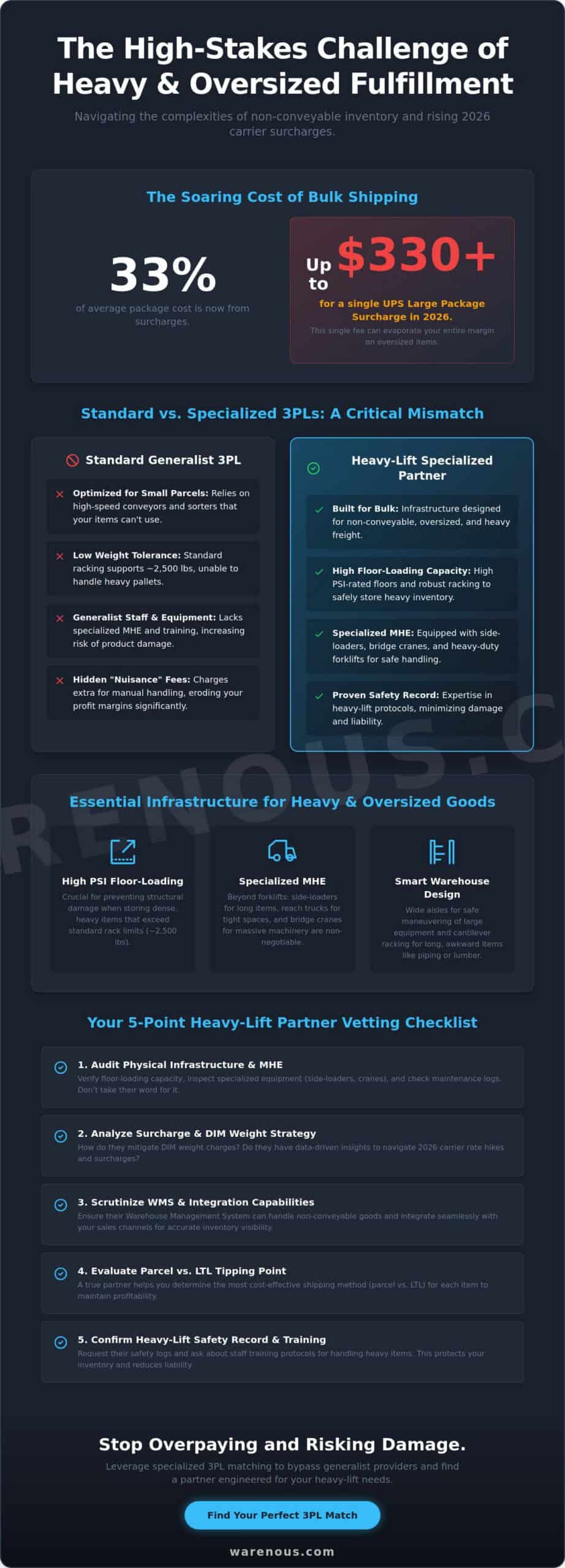
Surcharges now account for roughly 33% of the average package cost, but for bulky freight, a single UPS Large Package Surcharge in 2026 can exceed $330. If you ship furniture, industrial equipment, or oversized pallets, you’ve likely watched your margins evaporate through high dimensional weight fees and frequent shipping damage. Finding a 3PL for heavy or oversized items is no longer just about renting floor space. It’s a high-stakes infrastructure challenge that requires specialized handling and precise technical execution.
Ready to compare 3PLs for bulky goods? Warenous matches furniture and homewares brands with vetted 3PLs that handle oversized items, for free. Find a 3PL for furniture.
You’ve likely experienced the frustration of providers who lack the right equipment or refuse to store non-standard dimensions. We understand that your business needs more than a warehouse; it needs a reliable system that scales without breaking your budget. This guide will show you how to secure a partner that protects your inventory and your bottom line. We’ll explore the latest 2026 carrier thresholds, essential equipment requirements, and how data-driven insights can help you optimize your network design for seamless, cost-effective fulfillment.
Key Takeaways
- Identify the specific material handling equipment and floor-loading capabilities required to prevent inventory damage and operational bottlenecks.
- Master the process of finding a 3PL for heavy or oversized items that uses data-driven insights to navigate 2026 DIM weight traps and carrier surcharges.
- Audit potential partners based on their WMS capabilities to ensure your non-conveyable goods integrate seamlessly with your existing sales channels.
- Determine the precise tipping point between parcel and LTL shipping to maintain profitability despite aggressive 2026 rate increases.
- Leverage specialized 3PL matching to bypass the risks of generalist providers and secure a partner with a proven heavy-lift safety record.
Why Standard 3PLs Fail at Heavy and Oversized Fulfillment
Most logistics providers optimize for the “average” parcel. They build their entire business model around small, light boxes that zip through automated sorters at high speeds. When you are finding a 3pl for heavy or oversized items, you’ll quickly realize that standard facilities view your inventory as a operational liability. They aren’t equipped for the physical reality of bulk freight. Their systems are designed for high-volume, low-weight throughput. Your oversized pallets or heavy machinery don’t just take up more space; they disrupt the entire operational flow.
Standard warehouses rely on Third-party logistics (3PL) models built around conveyor belts and vertical racking. If an item is too heavy for a standard rack or too large for a sorter, it becomes “non-conveyable.” This leads to immediate margin erosion. Generalist providers often apply “nuisance fees” or handling surcharges to compensate for the manual labor required to move your goods. They don’t necessarily want your business. Instead, they want your money to cover the inefficiency your products cause to their automated workflows.
The Reality of ‘Non-Conveyable’ Goods
In 2026 logistics standards, non-conveyable refers to any item that, due to its weight, dimensions, or irregular shape, cannot be safely processed by automated sorting systems or standard warehouse conveyors. These items require a different operational DNA. Instead of moving on a belt, your product requires manual intervention. This increases pick-and-pack fees significantly. Standard providers also lack the floor-loading capacity for truly heavy goods. They often store oversized items in “dead zones.” This leads to slow retrieval times, poor inventory visibility, and increased labor costs that eat into your profits.
Hidden Risks of Using a Generalist Provider
Safety and liability are the silent killers of profitability in mixed-use facilities. Heavy items create a “thud-factor” risk. In a warehouse designed for lightweight parcels, a 150-pound crate stored near fragile electronics is a disaster waiting to happen. Damage rates skyrocket when staff aren’t trained in specialized heavy-lift protocols. You need team members who understand weight distribution and load securing. Generalist staff often lack this expertise, leading to damaged inventory and potential legal liabilities. Finding a 3pl for heavy or oversized items requires looking beyond the rate card. You must audit the facility’s physical safety culture and equipment standards to ensure your inventory remains intact.
Essential Infrastructure for Handling Bulk and Oversized Goods
Physical infrastructure dictates operational success in heavy logistics. Most standard warehouses are engineered for lightweight, high-velocity consumer goods, meaning their racking systems and floor slabs have strict weight tolerances. When finding a 3pl for heavy or oversized items, you must look beyond the square footage. You are looking for an engineering match. Just as you would vet a specialized property through A.Z. GWARANCJA Nieruchomości to ensure structural and locational suitability, finding the right 3PL requires verifying that the facility’s physical capacity meets your inventory’s demands. If a provider’s facility isn’t rated for high-density weight, your inventory becomes a safety hazard and a bottleneck.
Floor-loading capacity is the first metric to verify. Standard pallet positions in vertical racking typically support around 2,500 lbs. If your products exceed this, they must be floor-loaded. This requires a warehouse with a high PSI (Pounds per Square Inch) floor rating to prevent structural cracking. Strategic network design ensures your inventory is placed in facilities engineered for these high-density, heavy-load operations, protecting both the building and your assets.
Beyond the Forklift: Specialized MHE
Standard forklifts have clear limitations. For industrial-scale fulfillment, your partner needs specialized Material Handling Equipment (MHE). Side-loaders and reach trucks are essential for long, awkward items like timber or industrial piping that cannot navigate standard aisles. If you ship massive machinery, look for facilities equipped with overhead bridge cranes or heavy-duty hoists. These tools allow for precise movement without the risk of tipping or dropping. Ask about their equipment maintenance logs; a 3PL that invests in MHE reliability is a partner that won’t let your supply chain stall due to mechanical failure. For insights into maintaining high-performance industrial equipment, Alliance Fleet Solutions provides a detailed guide on strategic fleet optimization and maintenance.
Warehouse Engineering and Safety
The layout of the facility must accommodate the physics of heavy lifting. Standard 10-foot aisles are insufficient for side-loaders or heavy-duty lift trucks carrying oversized loads. You need a partner with wide-aisle configurations and cantilever racking. Cantilever systems are specifically designed for long, heavy items, providing open access without the interference of upright rack posts.
Loading dock infrastructure is equally critical. Oversized items often require wider dock bays and heavy-duty hydraulic levelers. If a dock leveler isn’t rated for the combined weight of the forklift and the oversized product, loading becomes a dangerous, slow process. Additionally, for metal industrial components, verify the facility’s humidity control. High-mass metal items are prone to condensation and flash rusting if the environment isn’t stabilized. Finding a 3pl for heavy or oversized items means auditing these technical details before signing a contract. You aren’t just buying space; you’re securing a facility built for the specific demands of your inventory.
For organizations that find existing third-party options insufficient and decide to develop their own purpose-built industrial sites, you can learn more about BuyVacantLand.com to understand the nuances of estimating property value before breaking ground.
Decoding the Cost: Dimensional Weight and Heavy-Item Surcharges
Logistics costs in 2026 are increasingly dictated by volume rather than actual mass. While standard General Rate Increases (GRI) hover around 5.9%, shippers of bulky freight face a harder reality. Due to aggressive surcharge structures, your actual costs could jump by 8-12% this year. Surcharges now account for roughly 33% of the average package cost. Finding a 3pl for heavy or oversized items requires a partner that understands how to mitigate these penalties through technical optimization and carrier selection.
Accessorial charges quickly turn a profitable sale into a loss. Residential delivery surcharges have climbed into the mid-$6 range, making final-mile delivery for oversized consumer goods a significant expense. If your product requires a liftgate or “White Glove” assembly, these fees stack. You must distinguish between parcel and Less Than Truckload (LTL) shipping thresholds. Parcel carriers like UPS now trigger Large Package Surcharges for items over 110 lbs or those exceeding 96 inches on the longest side. These fees can reach $330 per package in certain zones. Switching to an LTL network often becomes the more sustainable choice once your inventory hits these specific triggers.
Mastering Dimensional (DIM) Weight Calculations
The 2026 industry standard for calculating DIM weight remains (Length x Width x Height) / Divisor. Most carriers use a divisor of 139 for commercial shipments. If your package is large but light, you’ll be billed for the space it occupies, not its weight. Reducing “air” in your packaging is critical. A 3PL with data-driven insights can help you audit your packaging dimensions to lower your DIM factors. High-volume partners also have the leverage to negotiate better divisors, which directly protects your margins.
The LTL and Freight Landscape
Heavy items often move more efficiently through freight networks than parcel systems. LTL shipping relies on freight classes, which are determined by density, handling, and liability. A specialized partner uses warehouse optimisation to ensure goods are palletized correctly to achieve the best possible freight class. Deep integrations between your 3PL’s management system and freight carriers provide the real-time visibility needed to manage these complex shipments. This connectivity ensures you aren’t surprised by “over-limit” surcharges after the product has already left the dock.
Vetting Your Heavy-Lift Partner: A 5-Point Checklist
Selecting a logistics provider for standard parcels is a matter of comparing rates. However, finding a 3pl for heavy or oversized items requires a technical audit of their physical and digital capabilities. You aren’t just looking for a vendor; you’re looking for an operational match that can handle the liability of high-value, high-mass inventory. Use this 5-point checklist to separate generalists from true heavy-lift specialists.
- WMS Logic for Non-Conveyables: Verify if their Warehouse Management System (WMS) can calculate costs and track locations based on non-standard dimensions. If their software defaults to standard pallet sizes, you’ll face constant billing errors.
- Safety and Certification: Audit their OSHA or HSE safety records. A facility handling heavy machinery or oversized industrial goods must demonstrate rigorous training protocols for specialized equipment operation.
- Value-Added Kitting: Many heavy items require assembly or custom crating before the final mile. Test their expertise in kitting complex, oversized components to ensure they can handle post-manufacturing requirements.
- Carrier Leverage: Ask for specific data on their LTL and heavy-parcel contracts. A specialized 3PL should offer rates that mitigate the 2026 general rate increases through high-volume freight consolidations.
- Floor-Loading Scalability: Ensure the facility has dedicated floor space for your projected growth. Vertical racking is useless if your products require high-PSI floor positions.
The Operational Audit: What to Ask
Don’t rely on sales decks. During a site visit, speak directly to the floor manager about their MHE maintenance schedule. Ask to see damage rate data for products with similar weight profiles to yours. Verify their insurance coverage specifically for high-value heavy goods; standard “per pound” liability coverage is often insufficient for industrial machinery or high-end furniture. If you need a partner that passes this rigorous vetting process, our 3PL matching service connects you with pre-screened providers engineered for these specific challenges.
Technology and Integration
Tracking a 200-pound crate requires more precision than tracking a polybag. Your partner’s technology must provide real-time visibility across the entire freight journey, from the loading dock to the final liftgate delivery. For B2B industrial orders, seamless integration with your existing ERP system is mandatory to prevent manual data entry errors. WMS compatibility is the backbone of heavy-item logistics, ensuring that non-standard weights and dimensions don’t cause system errors or billing inaccuracies. This digital transparency allows you to manage your supply chain with the same speed and accuracy as a small-parcel shipper.
Finding Your Perfect Match with Warenous
Google searches for industrial logistics often lead to expensive mistakes. Generalist providers use aggressive SEO to capture “heavy-lift” keywords despite lacking the necessary floor-loading capacity or specialized material handling equipment. Finding a 3pl for heavy or oversized items through manual search usually results in a pile of rejected RFPs or a partnership that collapses under the weight of unexpected surcharges. Warenous eliminates this trial-and-error approach. We provide a pre-screened network of specialized providers who have already proven their ability to manage non-conveyable freight and high-mass inventory.
Our reach is truly global, addressing a critical gap in the logistics market. Whether you need a facility with high-PSI floor ratings in Sydney, specialized LTL integrations in Kansas City, or heavy-lift cranes in London, we connect you with the right infrastructure. We don’t just find you a warehouse; we secure a partner that fits your operational DNA. This global perspective ensures your supply chain remains resilient across multiple markets without the need for localized manual vetting.
Data-Driven Matching vs. Manual Search
Standard searches ignore technical constraints. We use your specific product dimensions and weights to filter our database, ensuring every match has the physical capacity to store and move your inventory. This precision saves you weeks of vetting and fruitless site visits. Our model is success-based. We’re incentivized to find you a long-term partner, not just a quick fix. Beyond matching, we provide expert network design and warehouse optimisation to ensure your logistics strategy scales alongside your business growth. We translate complex operational needs into measurable business value.
Seamless Transition and Implementation
Switching providers is a high-risk operation for heavy goods. Our project management support mitigates this risk by overseeing the technical details of the move. We ensure your data integrates correctly with the new facility’s WMS and that your physical inventory moves safely without operational downtime. This structured approach provides the predictability you need to maintain customer satisfaction during the transition. Finding a 3pl for heavy or oversized items shouldn’t be a gamble. It should be a calculated business move supported by data and professional oversight. Stop wasting resources on manual searches and start building a high-performance logistics network today.
Secure Your Heavy-Lift Logistics Network for 2026
Heavy-lift fulfillment is a technical challenge that standard providers aren’t built to solve. Success in 2026 requires more than just floor space; it demands a partner with the right floor PSI ratings, specialized MHE, and a deep understanding of complex surcharge structures. Finding a 3pl for heavy or oversized items is the most critical decision for protecting your margins against rising carrier fees and inventory damage. You need a system that offers predictability in an increasingly expensive logistics landscape. Modernizing your approach to partner selection is the only way to ensure operational stability.
Warenous removes the uncertainty from this process. Our pre-screened global network of heavy-lift specialists is engineered to handle your most difficult inventory with precision. We provide expert warehouse optimisation and network design to ensure your operations scale without friction. Our free matching service saves you weeks of manual vetting and high-stakes negotiation. Start your free 3PL matching process for heavy goods today and transform your logistics from a liability into a competitive advantage. Your inventory deserves a facility built for its specific needs. Let’s get to work.
Frequently Asked Questions
What is considered an ‘oversized’ item in 3PL fulfillment?
An item is oversized when its dimensions exceed standard carrier limits for automated processing. In 2026, carriers like UPS flag packages over 110 lbs or those with a longest side exceeding 96 inches. These goods are non-conveyable. They cannot move through high-speed sorting systems. Instead, they require manual handling and specialized floor storage positions that accommodate irregular shapes and high-density weight profiles.
Why do 3PLs charge extra for heavy items?
Heavy items increase operational wear and disrupt automated workflows. Most facilities are designed for lightweight parcels that move on conveyor belts. Bulky inventory requires specialized material handling equipment (MHE) and more manual labor per pick. Providers apply surcharges to cover the cost of high-PSI floor space and the specialized training required for staff to handle these goods safely without damaging other inventory.
What equipment should a heavy-lift warehouse have?
A specialized facility must possess more than basic forklifts. Look for side-loaders and reach trucks for long or awkward items. Industrial-scale operations require overhead bridge cranes or heavy-duty hoists. Additionally, verify the presence of hydraulic dock levelers rated for extreme weight. These tools ensure that loading and unloading processes remain efficient and safe, preventing structural damage to the facility or your products.
Can I use a standard e-commerce 3PL for furniture or gym equipment?
Using a generalist provider for gym equipment or furniture is a high-risk strategy. Standard facilities lack the floor-loading capacity and specialized racking needed for high-mass inventory. You will likely face excessive damage rates and “nuisance” fees because your products don’t fit their high-velocity sorters. Specialized providers offer the infrastructure and trained personnel necessary to protect your margins and inventory during the fulfillment process.
How do I calculate the shipping cost for a 50kg item?
Shipping costs for a 50kg item are determined by the greater of actual weight or dimensional (DIM) weight. Apply the 2026 industry formula: (Length x Width x Height) / 139. If the volumetric weight exceeds 50kg, you’ll be billed at that higher rate. Also, factor in Large Package Surcharges. These fees can exceed $300 for items of this size, making accurate packaging dimensions critical for profitability.
What is ‘White Glove’ delivery and do I need it?
White Glove delivery includes inside placement, assembly, and packaging removal at the final destination. You need this service if your products, such as industrial machinery or high-end furniture, require professional setup. It provides a premium customer experience and significantly reduces return rates. For specialized architectural installations, such as heavy window replacements, partnering with a licensed expert like A ACME Design ensures that fragile glass components are handled with the necessary technical precision. Ensuring the product is functional upon delivery protects your brand reputation and eliminates the logistical complexity of the customer handling heavy items alone.
How does a 3PL matching service work for heavy goods?
A matching service like Warenous uses your specific technical requirements to filter for facilities with the correct engineering. We analyze your product weights and dimensions to find providers with the right MHE and floor-loading capacity. This data-driven approach simplifies finding a 3pl for heavy or oversized items by removing manual search errors. We connect you with pre-screened partners who can actually handle your operational load.
Is LTL shipping always cheaper than parcel for heavy items?
LTL is typically more cost-effective once an item exceeds 150 lbs or triggers the 2026 over-limit parcel surcharges. However, parcel shipping offers faster transit times and fewer touchpoints. A professional audit of your network design will identify the exact tipping point where freight becomes cheaper than heavy-parcel. Balancing these methods is essential for maintaining a seamless fulfillment process that protects your margins without sacrificing delivery speed.