
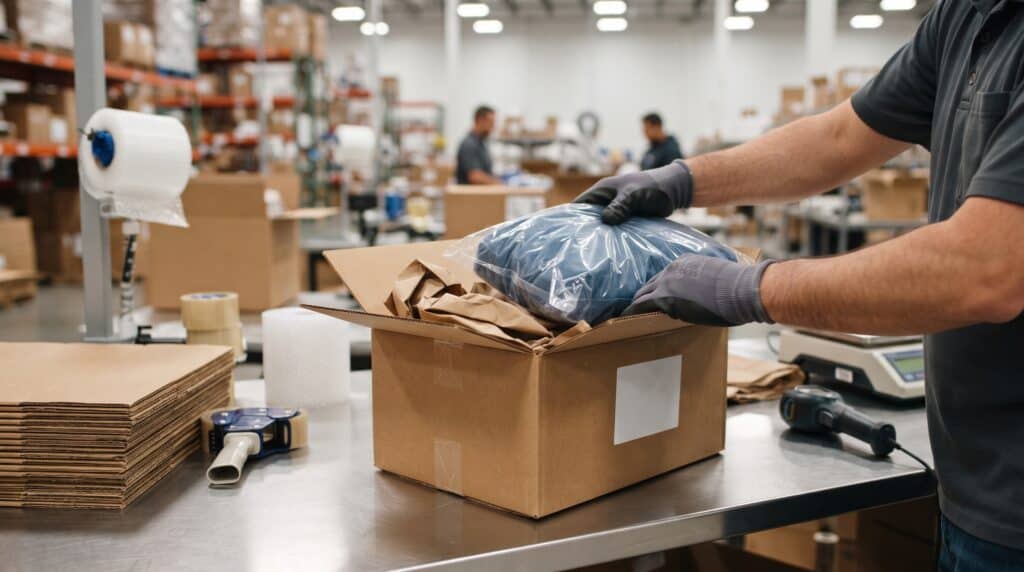
Outsourcing ecommerce fulfillment means handing storage, picking, packing and shipping to a third-party logistics provider (3PL). It usually makes sense when packing orders is taking time away from growing the business, when you are running out of space, or when a 3PL’s carrier rates and locations would cut your shipping costs. Compare the total cost per order, including shipping, before you decide.
Most brands start by packing orders themselves. At some point, the garage, the spare room or the small warehouse becomes the thing holding growth back. This guide to outsourcing ecommerce fulfillment covers the signs it is time to outsource, what it costs, how to choose a 3PL and how to move without disrupting orders.
When does outsourcing ecommerce fulfillment make sense?
Common signs you have outgrown doing it yourself:
- Your time: you or your team spend more time packing than on product, marketing or customers.
- Space: stock is overflowing, or you are about to sign a lease to get more room.
- Peaks: sales events create backlogs and late deliveries.
- Errors: wrong items and missed orders are rising as volume grows.
- Shipping costs: you cannot get the carrier rates or delivery speeds that larger shippers get.
- New markets: you want to sell into another region or country without opening your own warehouse there.
| In-house | Outsourced to a 3PL | |
|---|---|---|
| Costs | Mostly fixed: rent, staff, equipment | Mostly variable: pay per pallet, order and parcel |
| Control | Full control of process and packaging | Agreed through the contract and service levels |
| Peaks | You hire and train extra staff | The 3PL flexes its labour |
| Shipping rates | Your own volume | Often access to the 3PL’s negotiated rates |
| Locations | One site, usually near you | Can be near your customers, or several sites |
Some businesses are better staying in-house, for example with very bulky or specialised products. If that is you, see our warehouse consulting services.
What does outsourcing ecommerce fulfillment cost?
A 3PL quote usually includes:
- Receiving: per pallet, carton or hour when stock arrives.
- Storage: per pallet, shelf or bin per week or month.
- Pick and pack: per order, plus a smaller fee for each extra item.
- Packaging: supplied by the 3PL at a cost, or provided by you.
- Shipping: carrier cost per parcel, usually the biggest line.
- Other: setup or onboarding fees, account management, returns and monthly minimums.
For typical rates and how the models work, see 3PL warehouse costs explained and 3PL pricing models.
When we priced five 3PLs on the same six months of real orders for an online apparel brand, total annual cost ranged from about A$260,000 to A$334,000. Shipping made up 60–67% of each total, so the 3PL with the lowest storage rate was not the cheapest overall. Always compare the full cost on your own orders.
How do I choose the right fulfillment partner?
- Product fit: do they already handle products like yours (size, value, fragility, temperature, compliance)?
- Volume fit: are you a meaningful customer for them, or too small or too large for their operation?
- Location: are they close to your customers, or to where your stock lands?
- Technology: do they integrate with your store and marketplaces, with live inventory and tracking?
- Service levels: order cut-off times, dispatch targets, accuracy and how they handle mistakes.
- Contract terms: length, notice period, minimums and exit terms.
Our guide to choosing the right 3PL warehouse goes into more detail, and 3PLs for smaller businesses covers what to expect at lower volumes.
How do I move to a 3PL without disrupting orders?
- Clean your product data: one barcode per SKU, accurate dimensions and weights.
- Connect and test systems: send test orders from your store through to a printed label before any stock moves.
- Send stock in stages: keep enough at your current location to fulfil orders while the first deliveries are received.
- Switch over in a quiet period: avoid launching just before a major sales event.
- Watch the first weeks closely: check accuracy, dispatch times and stock levels daily.
Most moves take around four to eight weeks from signing to full go-live.
Related: Choosing a 3PL is like hiring a star employee · 3PL cost calculator · Hidden costs of using a 3PL
Frequently asked questions
Is outsourcing ecommerce fulfillment worth it for a small brand?
Often, yes, once order volume is steady and packing is taking up valuable time. Check minimum monthly fees carefully, as they can make outsourcing expensive at very low volumes.
Can I keep my branded packaging when outsourcing ecommerce fulfillment?
Most can. You supply the packaging, inserts or instructions, and they pack to your specification. Confirm any extra handling fees first.
How long does outsourcing ecommerce fulfillment take to set up?
Usually four to eight weeks, covering system integration, testing and moving stock. Complex catalogues or several sales channels can take longer.
What happens if the 3PL makes a mistake?
Your contract should set accuracy targets and say who pays for re-shipping and lost or damaged stock. Agree these before you sign.
Should I use one warehouse or several?
Start with one well-located site unless delivery times or shipping costs to distant customers are clearly hurting sales. Adding locations adds stock and complexity.
Ready to start outsourcing ecommerce fulfillment?
Warenous matches you with pre-screened 3PLs that suit your products and volume, and compares their quotes on your real orders, for free.
Book a free call with a 3PL expert




